1. South-Central Wisconsin Microclimate Dynamics & Severe Storm Exposure
Madison’s unique geography--situated on an isthmus between Lake Mendota and Lake Monona within Dane County--generates localized meteorological microclimates that exert intense thermodynamic and kinetic stress on roofing assemblies. In spring and summer, warm moist Gulf air collides with colder Canadian airmasses, fueling supercells characterized by high-velocity downdraft winds exceeding 60 to 80 mph and hail diameters frequently surpassing golf ball dimensions (1.75 inches). When these storm fronts sweep across Middleton, the west side of Madison, and Verona, windward roof slopes absorb tremendous perpendicular impact energy while leeward slopes endure powerful vortex suction forces that break factory shingle sealants.
In winter, Dane County temperatures drop below zero for prolonged stretches, punctuated by sudden solar radiation thaw cycles. This extreme freeze-thaw oscillation causes severe differential thermal movement between wood decking, asphalt coatings, and metal flashings. Snowpacks melting on uninsulated upper roof pitches flow downward until encountering cold unheated eaves, where meltwater refreezes into massive ice dams. This hydrostatic barrier forces water upward against gravity, bypassing shingle overlaps and soaking structural rafters, attic blow-in cellulose, and finished living space drywall.
Localized Meteorological Risk Factors in Madison
- Kinetic Hail Impacts: Terminal velocity hail bruising fiberglass shingle scrims and dislodging mineral granules into gutters.
- Microburst Wind Uplift: Aerodynamic edge shear peeling starter strips and lifting unsealed laminated shingle tabs.
- Thermal Ice Damming: Eave meltwater backup penetrating beneath organic felts during January and February sub-zero cycles.
- Heavy Snowpack Loads: Wet, dense snow loads exceeding 30 to 45 lbs/sq ft causing rafter deflection and seam rupture on low-slope additions.
2. Non-Destructive Moisture Diagnostics & FLIR Thermal Tracing
Locating the exact point of exterior water entry based on an interior ceiling drip is notoriously misleading. Water routinely enters through a damaged valley flashing, cracked pipe boot, or bruised shingle tab twenty feet away, traveling horizontally along sloped rafters and poly vapor barriers before emerging at an electrical light fixture or drywall seam. Qualified independent roofing technicians dispatched across Madison utilize calibrated forward-looking infrared (FLIR) thermal imaging cameras to conduct non-destructive moisture tracing across interior ceilings and attic spaces.
Thermal imaging exploits the evaporative cooling differential and thermal capacitance of water. Wet building insulation and saturated plywood roof sheathing retain temperature differently than adjacent dry materials. When scanned during evening cooling transitions, moisture intrusion paths illuminate distinctly on high-resolution thermographic palettes. Technicians cross-verify these thermal anomalies using non-invasive impedance radio-frequency moisture meters, precisely mapping moisture boundaries without puncturing drywall or compromising structural vapor barriers.
Diagnostic Testing & Verification Protocol
- High-Resolution FLIR Thermography: Identifies invisible trapped moisture reservoirs within insulated attic cavities.
- Pinless Dielectric Impedance Scans: Quantifies percentage of moisture content within plywood and OSB roof sheathing.
- Rooftop 10x10 Test Squares: Quantifies localized hailstone strikes and granule spallation per 100 sq ft directional exposure.
- Optical Borescope Deck Inspection: Evaluates rafter rot and fastener integrity without destructive drywall demolition.
3. Step-by-Step Substrate Restoration Methodology
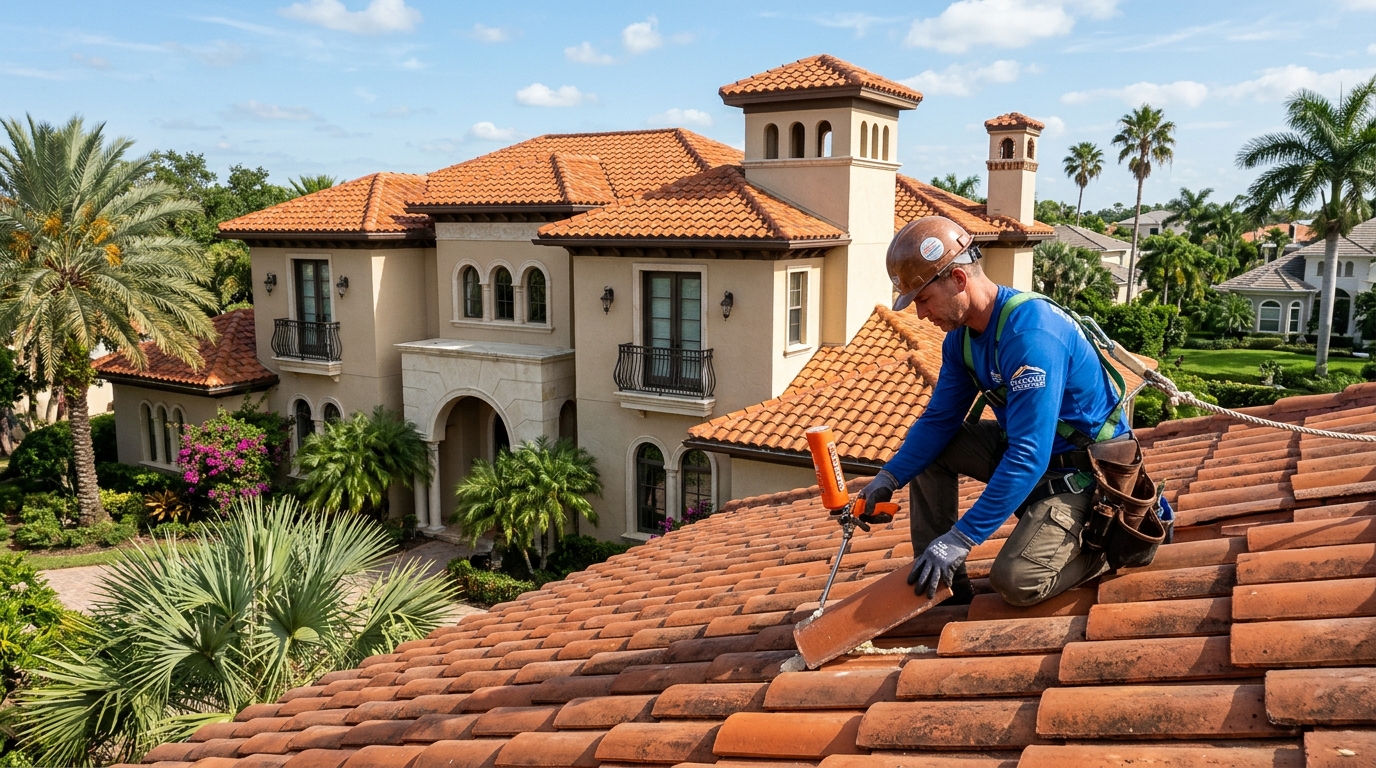
Effective emergency roofing repairs require systematic execution following structural engineering principles. When independent field crews arrive at your Madison property, they implement a methodical multi-stage mitigation protocol designed to immediately stop water ingress and establish a durable barrier:
- Immediate Hazard Triage & Interior Water Containment: Disconnecting electrical circuits near active ceiling fixtures, setting commercial polyethylene containment funnels, and relieving hydrostatic ceiling pressure with relief punctures to prevent catastrophic drywall collapse.
- Rooftop Inspection & Debris Removal: Safely accessing the roof using pitch-calibrated ladder systems, clearing storm tree limbs, and removing saturated debris from affected valley troughs and drainage scuppers.
- Damaged Material Demolition: Using specialized shingle rippers to carefully extract fractured shingles, cracked cedar shakes, or corroded metal flashings down to sound wood decking without tearing adjacent sound underlayments.
- Substrate Decking Inspection & Timber Re-fastening: Examining plywood/OSB sheathing for delamination, dry rot, or nail-pull failures. Reinforcing weak decking with exterior-grade CDX plywood and ring-shank fasteners.
- Application of Self-Adhering Polymer Ice Barriers: Installing high-tack rubberized asphalt membrane directly over clean decking, ensuring complete self-sealing adhesion around all fastener penetrations.
- Integration of Code-Compliant Roofing Materials: Weaving new architectural laminated shingles, No. 1 Certi-Split cedar shakes, or heavy-duty step flashing with corrosion-resistant hot-dipped galvanized nails driven flush below the sealant line.
4. Wisconsin SPS 321 / 322 Energy & Building Code Compliance
In Wisconsin, residential dwelling construction and structural roofing alterations are governed by the Wisconsin Administrative Code, specifically SPS 321 (Construction Standards) and SPS 322 (Energy Conservation). Adherence to these legal requirements ensures that emergency repairs and permanent restorations meet mandatory structural wind-load and insulation thresholds across Dane County municipalities:
- Mandatory Ice Barrier Protection (SPS 321.28): On all roof pitches, an ice dam protection membrane consisting of a self-adhering polymer-modified bitumen sheet must extend from the eave edge to at least 24 inches inside the interior exterior wall line.
- Minimum Rafter Fastener Spacing: Shingles installed in Dane County must utilize minimum 11-gauge or 12-gauge corrosion-resistant barbed or ring-shank roofing nails driven with 4 to 6 fasteners per shingle strip to satisfy 90 mph basic design wind speeds.
- Attic Ventilation Balancing (SPS 322.39): Roof assemblies must provide a balanced 1:300 ventilation ratio between continuous soffit intake vents and ridge exhaust baffles to exhaust hot, moist air in summer and maintain cold attic temperatures in winter.
- Wisconsin Contractor Credentialing: Field contracting entities must hold active Wisconsin Dwelling Contractor Financial Responsibility (DCFR) credentials and employ licensed Dwelling Contractor Qualifiers (DCQ) to obtain municipal building permits in Madison, Middleton, and Sun Prairie.
5. Preventative Property Maintenance & Severe Storm Preparedness
Proactive maintenance drastically reduces the vulnerability of your Madison home to catastrophic storm breaches. Implementing seasonal roofing inspections and maintenance routines ensures minor flashing gaps or cracked neoprene collars are resolved before severe hailstorms or blizzard freezes strike:
Examine shingles for winter ice dam lift, cleared valley metals, and clean out winter grit accumulation from gutters and downspouts.
Prune overhanging oak and maple limbs back at least 10 feet from the roofline to prevent microburst wind branches from puncturing decking.
Inspect chimney counter-flashings, skylight seals, and plumbing boot collars. Replace dried neoprene boots before freezing snow arrives.
Technical Repair Options Comparison: Skylight Curb Waterproofing & Plumbing Pipe Boot Collar Repair in Madison, WI
Need Immediate Skylight Curb Waterproofing & Plumbing Pipe Boot Collar Repair in Madison, WI Dispatch in Madison?
Speak directly with our Dane County dispatch coordinator. Qualified independent roofing crews are on-call across Madison, Middleton, Sun Prairie, Fitchburg, and Verona.
CALL (888) 208-4155 NOW